

Star Instrument of Fallen Stars … a home-brew AD&D 1e item

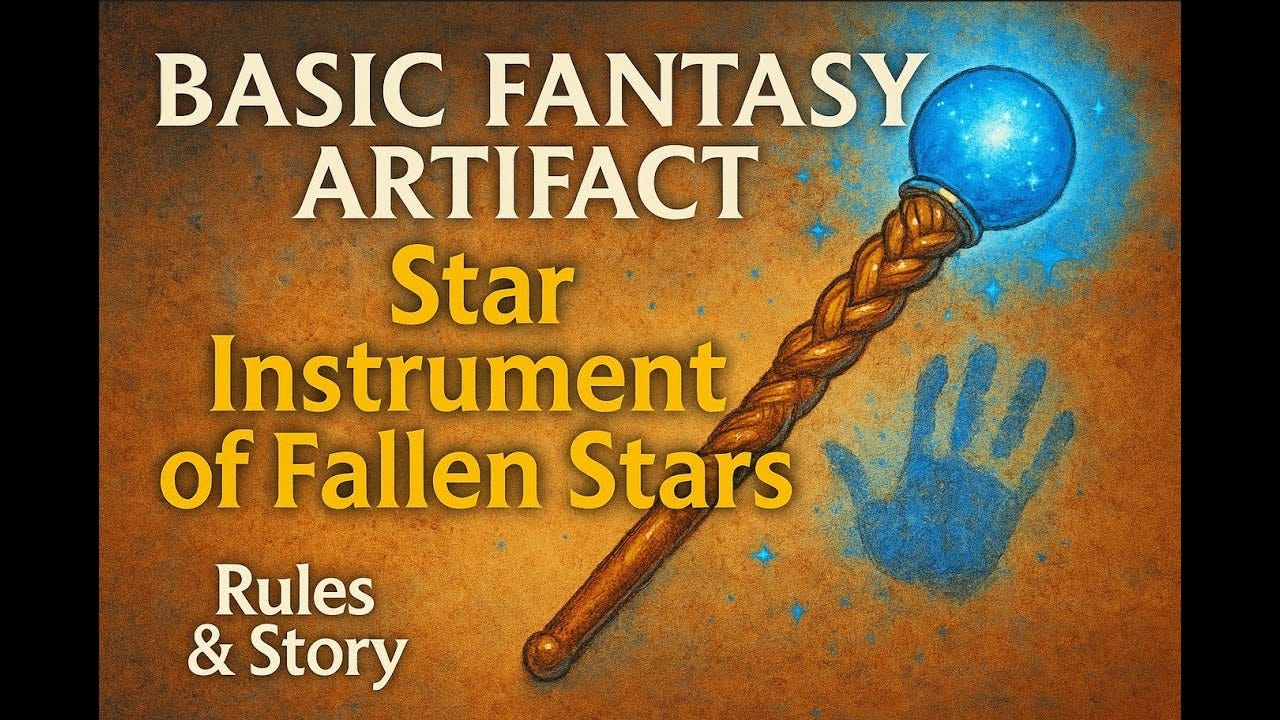
I’ve been noodling with a weird little artifact for AD&D 1e, and tonight’s video walks through how I’d run it at the table without wrecking the campaign economy or the tone. It’s not from the DMG, not a renamed classic… just a home-brew that grew out of a note in my binder that read, “braided hair scepter from the sky.” Sometimes that’s all you need to get in trouble.
Here’s the vibe. Imagine a short scepter that’s cool as snowmelt, braided like a coronation cord, and just a bit too interested in whoever is holding it. It doesn’t shout power. It hums. It smiles in frost. I wanted something that helps a low-talking king fix a bridge at midnight, then quietly ruins his friendships by dawn. Helpful and dangerous in the same breath… that’s the sweet spot for magic in 1e.
Design goals were simple. It had to feel ancient without reading like a shopping list. It needed a couple of table-ready tricks that players actually use, not just wall text. It also needed a cost that isn’t hit point loss or level drain every five minutes. Social chill is the price here. The item makes doors open… then closes a few hearts. That tension plays great in court scenes, temples, and any town where the hirelings talk more than the heroes.
In the video I walk through how I slot it into an AD&D 1e game. No spreadsheets. No taxonomy of artifact tiers. Just the practical stuff… how often it lights up, how loud that hum gets, how I handle flight so it feels magical instead of tactical, how long the big guardian sticks around before it drifts off like stardust. I also talk about keeping the mystery intact. Players can learn what it does, but not why it chose them. That uncertainty keeps them curious and just a little nervous.
You’ll hear some story how I’ve used at the table. A bridge mended in one night. A ledger that writes names in frost. A silver net packed in salt. These are breadcrumbs, not spoilers. Use them to yank the party toward the next scene, then let the item complicate their plans in small, satisfying ways. Give them a win… then let the room go cold when they try to negotiate with good folk who can feel something is off.
If you’re a 1e ref who likes treasures that push behavior, this one should fit right into your kit. Treat it like a crown the party can carry. It makes things easier until it doesn’t. That’s when players start asking good questions and making interesting choices, which is the whole point.
Watch here: